Approximate elevation of the archaeological site.
Underwater archaeology · The interrupted journey
The Torre Flavia *dolia* ship
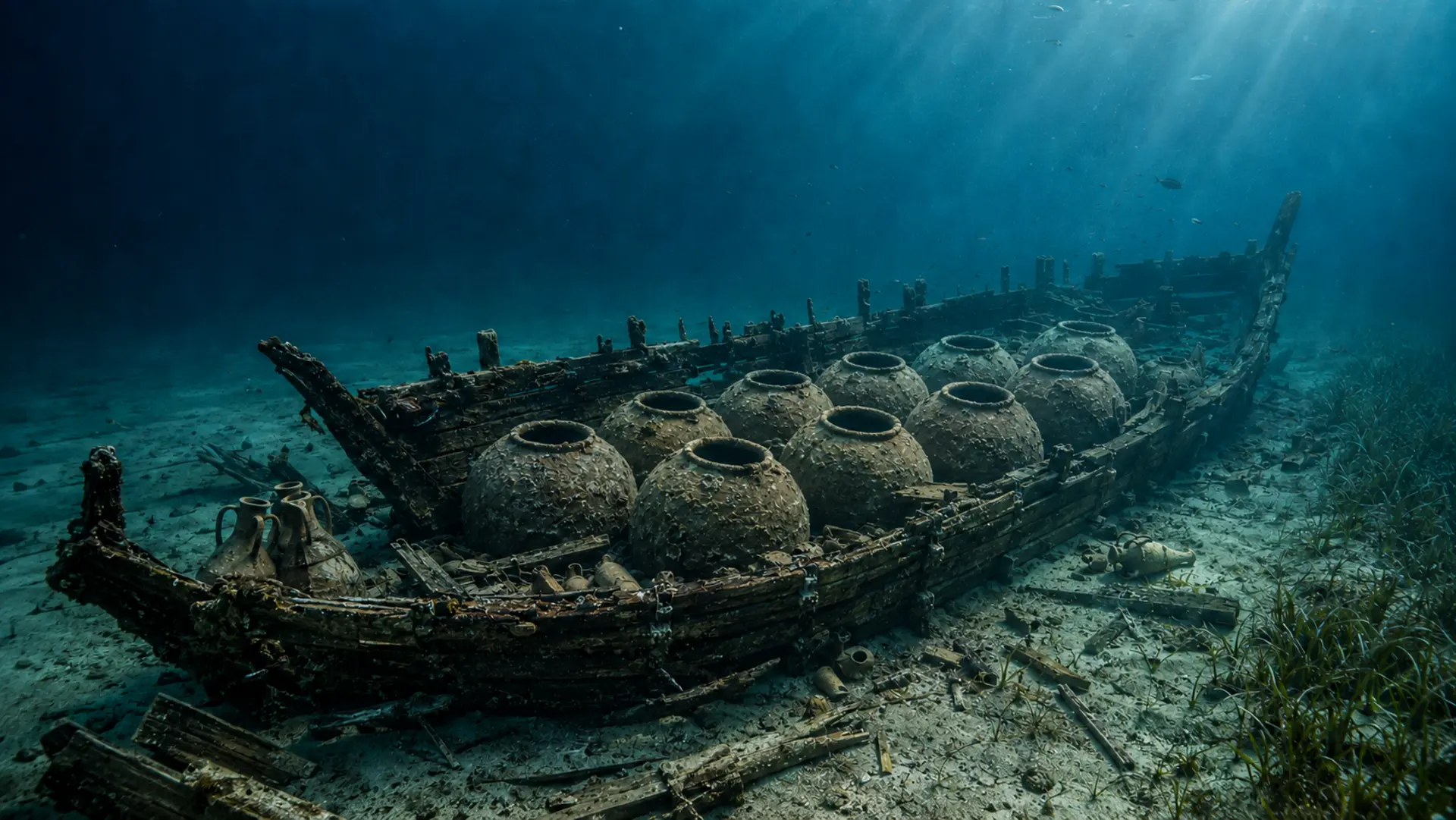
Between the late 1st century BC and the early 1st century AD, a merchant ship sank off the coast of Ladispoli, carrying huge wine jars, amphorae, and the crew's everyday items. The wreck offers insights into trade, shipbuilding, and life on board.WhereLadispoli waters · shipwreck coordinates not published
PeriodLate 1st century BC–early 1st century AD
AccessShipwreck not open to visitors · artifacts housed in the Santa Severa museum
THE SITE AT A GLANCE
A terracotta storage vessel inside the ship's hull.
The shipwreck, discovered in 1983 and studied during three campaigns between 1983 and 1985, lies at a depth of approximately twelve meters. The remains were scattered over an area of about four hundred square meters; a section of the hull planking measuring 6.60 by 3.30 meters was preserved. Based on this fragment, scholars have estimated the original length of the ship at approximately 18–20 meters; this is an estimate, not a measurement of the complete hull.
Five large, intact *dolia* and numerous fragments suggest an original cargo of ten to twelve containers, with a total theoretical capacity approaching fifty tons. Resin-lined inner walls and Dressel 2–4 wine amphorae indicate that wine was likely being transported. Stamps linked to the Minturnae area suggest production ties with southern Lazio, though they do not reveal a specific route or the port of destination.
The flat-bottomed hull—built with mortise-and-tenon planking and reinforced in the central section—was designed to carry an exceptional load. However, a sounding weight, wooden bilge-pump discs, sgraffito tableware, a duck-head decoration, and a lidded box interpreted as a medical kit bring the story back to the human scale of those who sailed.
AN ACTUAL ARTIFACT, THE MUSEUM, AND FOUR COMPARISONS
From salt on terracotta to the shape of the ship.
The first photograph is indeed of a *dolium* (large storage jar) recovered from the shipwreck. The other images show the museum, the coastal landscape, or comparative examples; they are never presented as photographs of the underwater excavation itself.
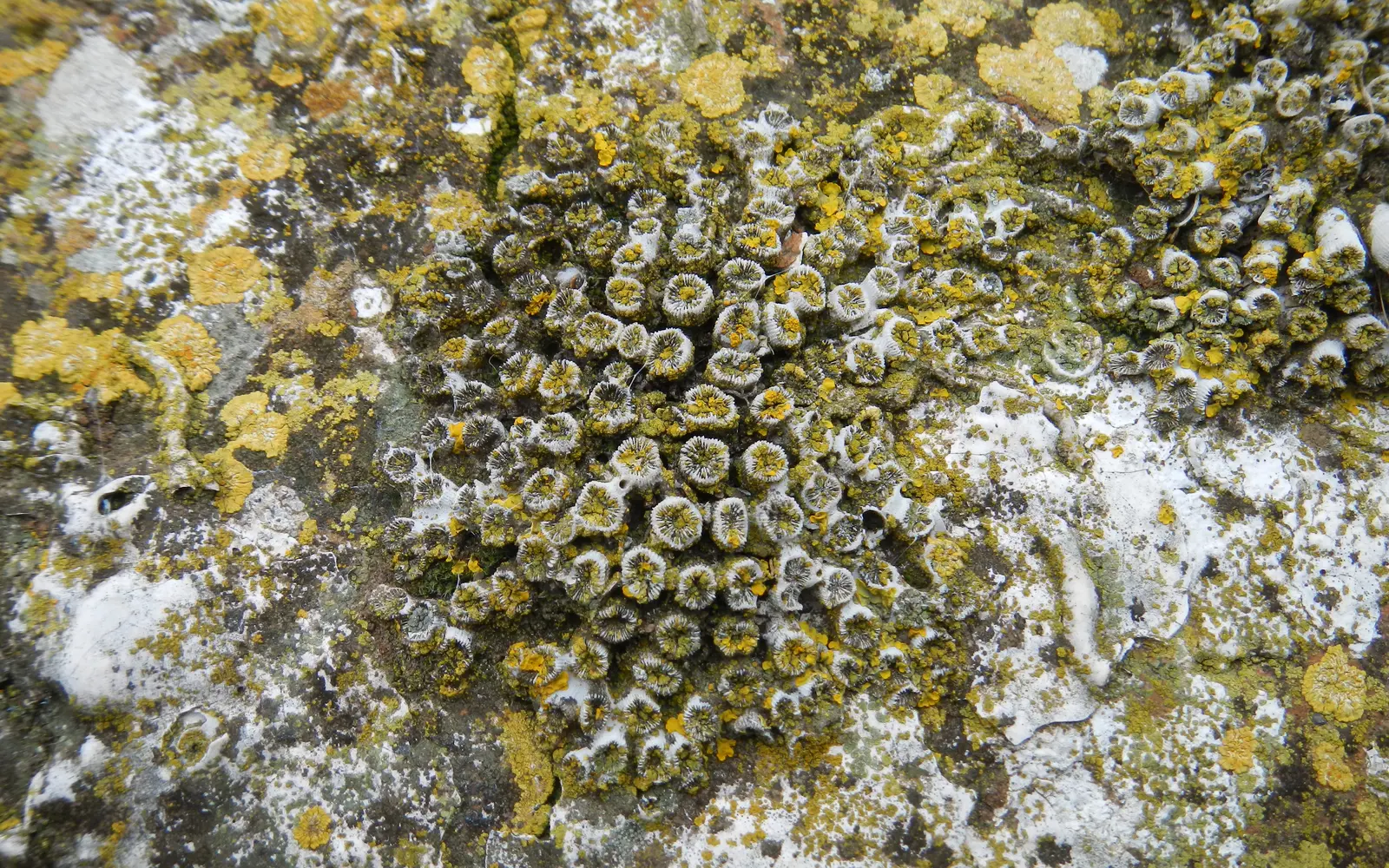
Traces of the sea on the terracotta
Madreporal corals and encrustations mark the surface of one of the *dolia* recovered and preserved at Santa Severa. This is a macro detail of the artifact, not a view of the entire container.
Viscardo Squartini / Wikimedia Commons · CC BY-SA 3.0 · cropped and converted to WebP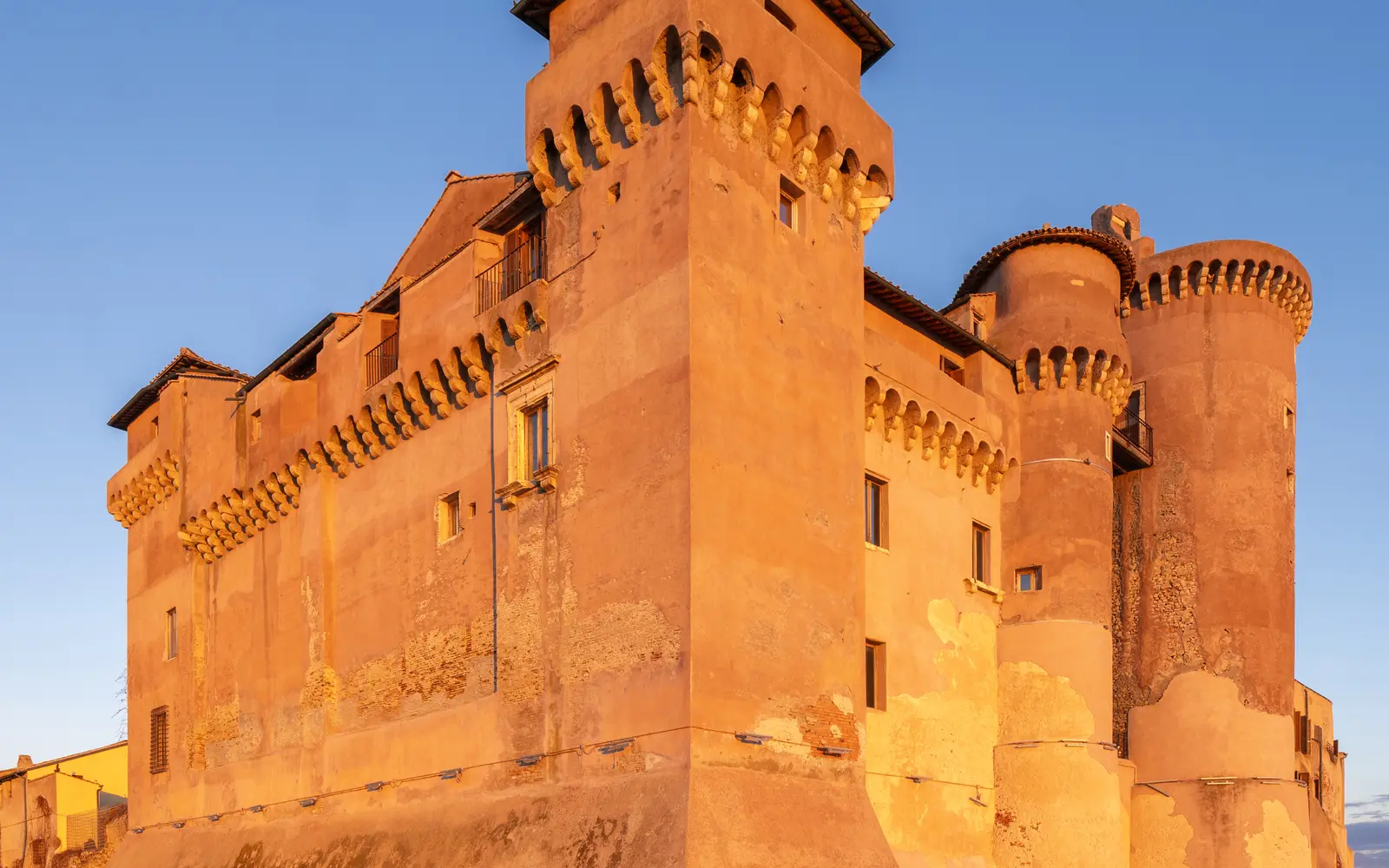
The story continues at Santa Severa.
Within the Castle complex, the Museum of the Sea and Ancient Navigation houses the restored *dolia* (large storage jars) and reconstructs the ship's hold to illustrate the scale and organization of the cargo.
Fiat 500e / Wikimedia Commons · CC BY 4.0 · cropped and converted to WebP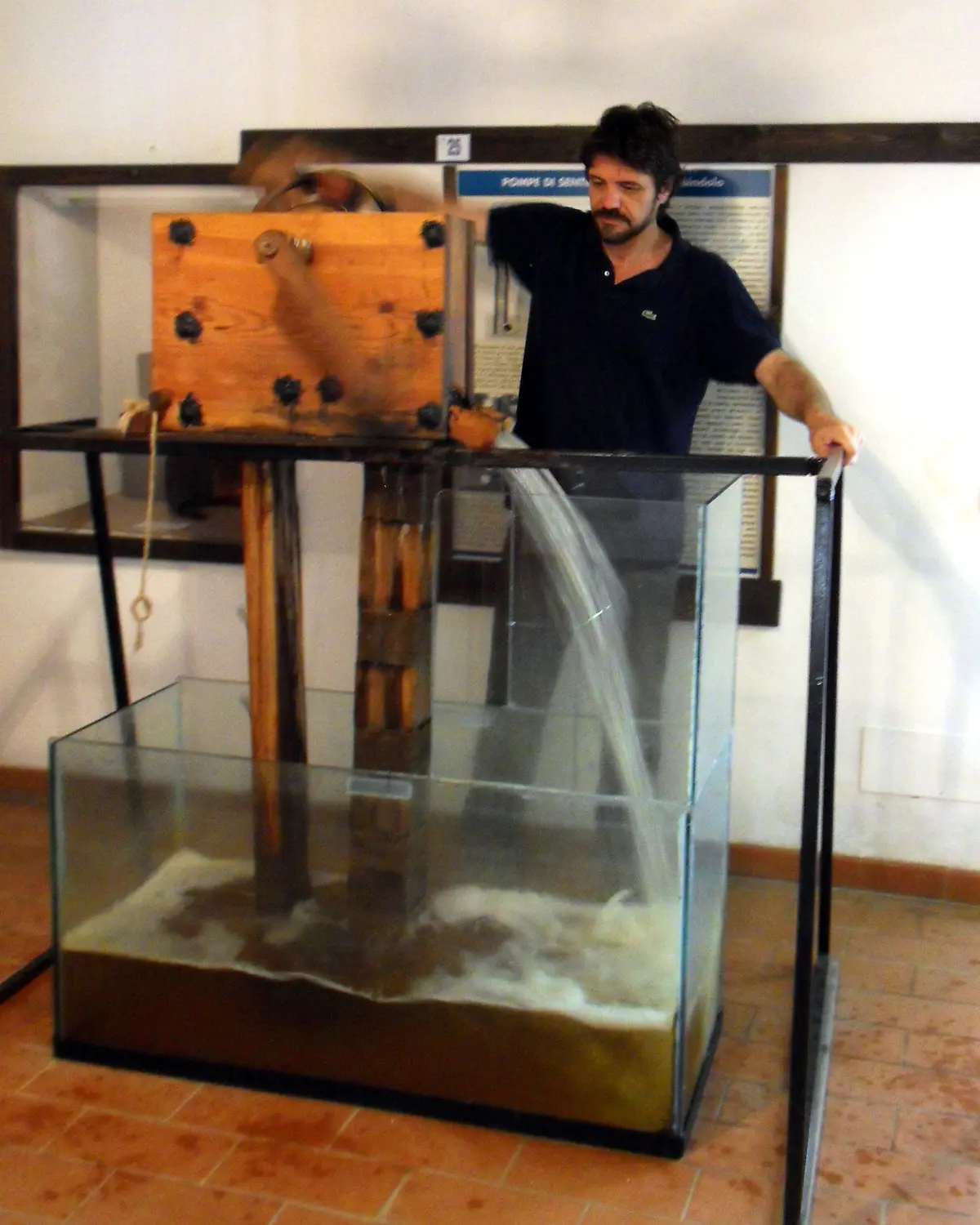
Water outside the bilge
The pump shown in the photograph is an educational replica, not an original part of the ship. However, it helps interpret the perforated wooden discs found on board, which were part of a pumping system.
Lorenot / Wikimedia Commons · CC BY-SA 4.0 · cropped and converted to WebP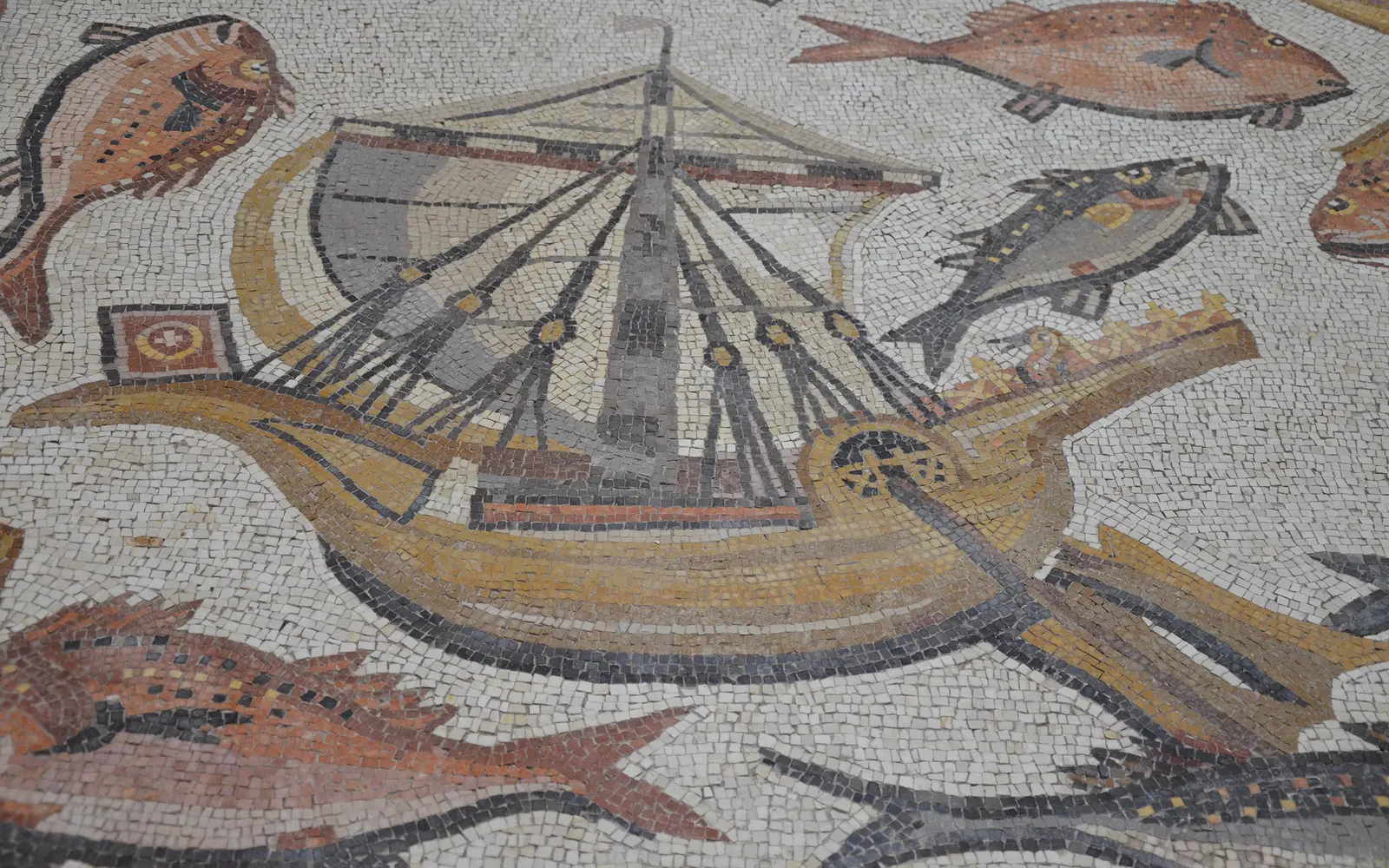
How the Romans envisioned a merchant ship
The Lod mosaic dates from about three centuries later and does not depict the Ladispoli shipwreck. It merely offers an iconographic comparison regarding the mast, sail, hull, and steering mechanism of a merchant ship.
Following Hadrian / Wikimedia Commons · CC BY-SA 2.0 · cropped and converted to WebP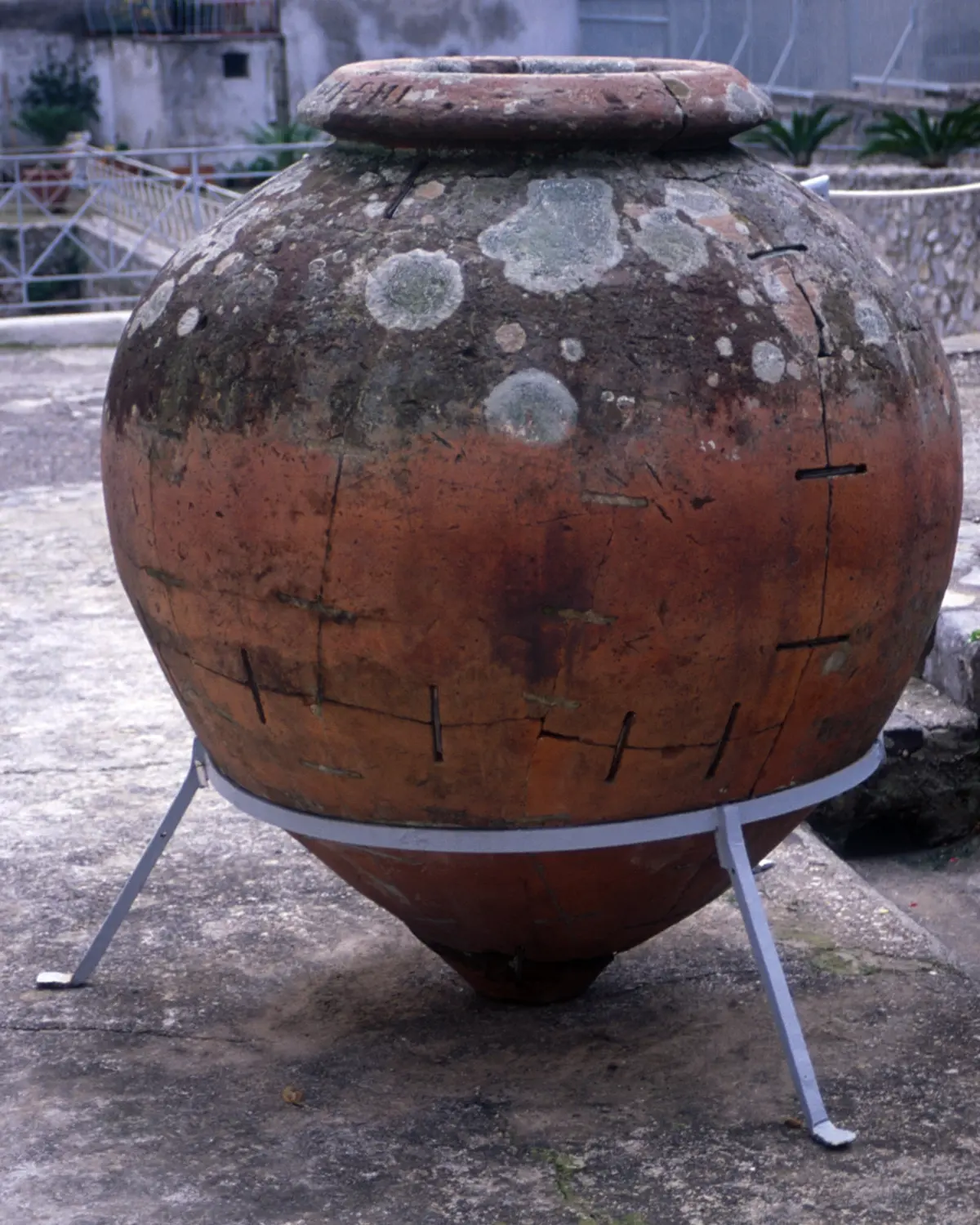
A vessel larger than a person
The *dolium* in the photograph comes from the Roman villa at Minori, not from the ship. This comparison makes it possible to visualize the shape, thickness, and scale of these large, stationary transport or storage containers.
Tyler Bell / Wikimedia Commons · CC BY 2.0 · cropped and converted to WebP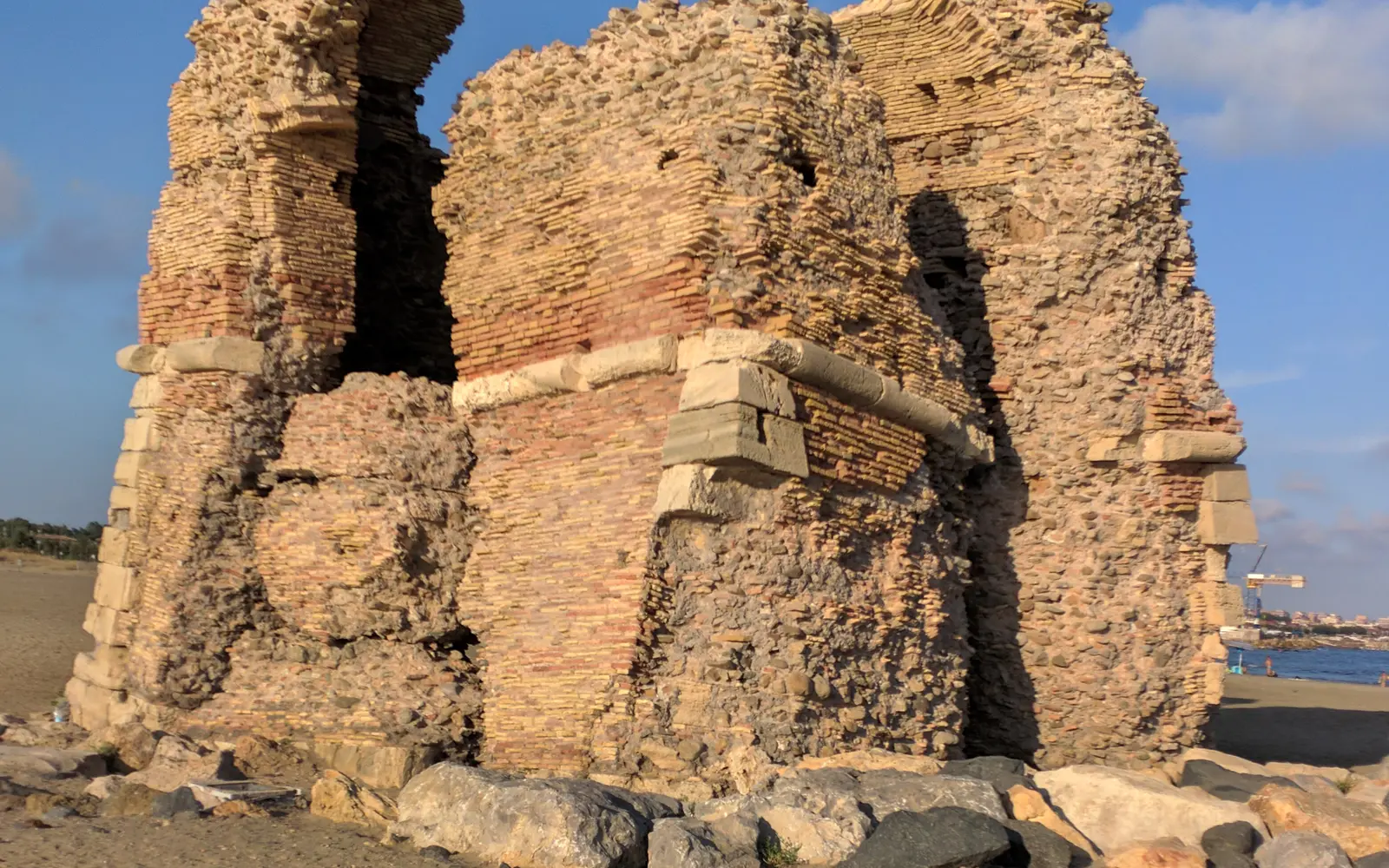
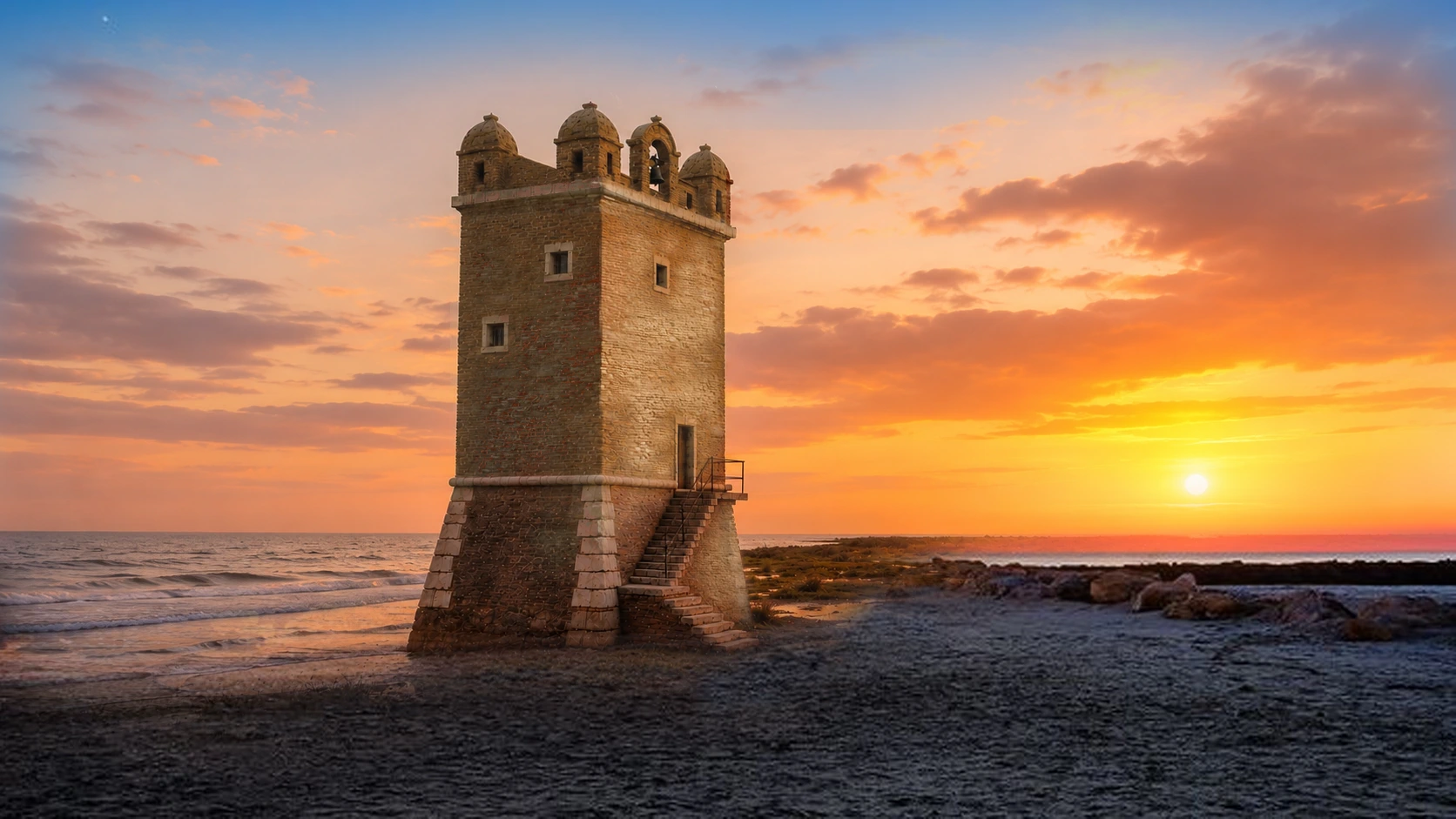
The tower provides the name, not the coordinates
Torre Flavia defines this coastal area in the public narrative. The photograph does not indicate the shipwreck site and should not be used to search for the wreck.
Sailko / Wikimedia Commons · CC BY 3.0 · cropping and WebP conversionWRECK DATA
What is measured and what is reconstructed.
The published data allow one to gauge the scale of the shipwreck, provided that the preserved dimensions are not confused with those hypothesized for the entire ship.
Approximate area containing documented remains.
Documented wooden section; not the dimensions of the complete ship.
Reconstruction of the original ship based on the remains.
Five intact vessels plus fragments support the estimate of the initial cargo.
Order of magnitude, not the weight of the cargo measured at the time of the shipwreck.
- 01Underwater survey
Documentation of the dispersion, planking, and positioning of materials during the 1983–1985 campaigns.
- 02Study of the hull
Analysis of planking, mortises, tenons, frames, and reinforcements to understand the construction method.
- 03Comparison of cargo load
*Dolia*, amphorae, resin, marks, and repairs are interpreted together, without turning clues into a definitive route.
- 04Museum display / Musealization
Restoration and reconstruction of the hold restore the original proportions and functions for the public without exposing the submerged site.
SIX CLUES WITHIN THE SAME SHIP
Cargo and life on board.
The ship carried more than just large vessels. Each group of artifacts sheds light on a different activity, ranging from navigation and maintenance to personal care.
- 01STRUCTURE
Planking and ribs
Planks approximately four centimeters thick, mortise-and-tenon joints, and closely spaced ribs form a sturdy hull, reinforced in the cargo area.
Scientific documentation and museum reconstruction - 02HOLD
Resin-coated and repaired *dolia*
The large jars were integral to the ship's design; their linings and lead clamps provide evidence of their use, maintenance, and economic value.
Artifacts restored in the museum - 03BOW AND STERN
Dressel 2–4 amphorae
Campanian wine containers accompanied the main cargo, likely placed in the spaces left open by the *dolia*.
Archaeological materials studied - 04BILGE
Pump and sounding lead
Perforated wooden discs and a lead weight provide evidence of water management and depth measurement during navigation.
Comparison with museum reconstructions - 05CREW
Tableware, graffiti, and furnishings
Utilitarian vessels, incised marks, and a wooden duck-head decoration evoke everyday actions and lived-in spaces.
Artifacts and publications - 06CARE
The small box interpreted as a medical kit
A closed wooden container with small compartments and remains—including coriander and cumin—suggests a therapeutic kit; the function is plausible, though not certain in every detail.
Archaeological interpretation
ESSENTIAL STEPS
The history,
in order.
Confirmed dates, archaeological phases, and traditions are presented for what they truly represent.
- 01
The shipwreck
A cargo ship laden with *dolia* and amphorae was lost off the coast of Ladispoli. Its origin, departure point, and destination remain unknown.
datazione archeologica - 02
The discovery
The shipwreck is located, and the first excavation campaign—directed by Valeria D’Atri and Piero Alfredo Gianfrotta—begins.
storia della ricerca - 03
Three underwater campaigns
The hull, cargo, and associated artifacts are documented, selectively recovered, and studied across an area of approximately four hundred square meters.
campagne documentate - 04
The first comprehensive publication
The *Bollettino d’Arte* presents the shipwreck, the *dolia* (large storage jars), and the onboard artifacts to the scientific community.
pubblicazione MiC - 05
The hull is re-examined
A study in *Archaeonautica* examines naval architecture, assembly systems, and hull-bottom reinforcements in depth.
studio scientifico - 06
Restoration and museum
Five *dolia* and their associated grave goods are being added to the exhibition at the Museum of the Sea and Ancient Navigation in Santa Severa.
musealizzazione documentata - 07
Protecting without pinpointing the location
The shipwreck remains part of the underwater heritage: public knowledge of it is gained through museums and documentary sources, not by independently searching for the sinking site.
tutela responsabile
WHAT TO OBSERVE
Reading the site,
detail by detail.
Structural containers
These enormous jars were not merely oversized amphorae; their weight and bulk dictated the construction and use of the ship's hold.
A probable load
Internal resin lining and wine amphorae support this interpretation, although no label indicating the original contents has survived.
Mediterranean carpentry
The hull was assembled using mortise-and-tenon joints before the internal structures were installed, following ancient shipbuilding traditions.
Repaired large jars
Lead clamps and pourings indicate that enormous vessels could be repaired rather than replaced.
Technology and daily life
The pump, sounding lead, tableware, and furnishings recreate the crew's daily work, going beyond the mere commercial history.
Viewing without diving
The reconstruction of the hold at Santa Severa makes the *dolia* system visible without endangering the shipwreck.
BEFORE GOING
The shipwreck is best understood in a museum, not by searching for it at sea.
The artifacts and a full-scale reconstruction of the ship's hold section are associated with the Museum of the Sea and Ancient Navigation within the Santa Severa Castle complex on the Via Aurelia. Opening hours, room access, and ticket details may vary depending on the season and current exhibitions.
Always check official channels before setting out. This page does not provide coordinates, alignments, buoy locations, or diving instructions. Do not search for, touch, or retrieve materials from the wreck; underwater archaeology requires permits and specialized preservation.The museum trail displays large *dolia* (storage jars) and shipboard artifacts within the context of ancient seafaring.
The complex operates on a seasonal schedule and is normally closed on Mondays; Check the official website for any changes.
Combined rates, temporary exhibitions, and access to different areas are subject to change: please consult the official ticketing page.
Please check directly before your visit regarding elevators, barrier-free access, facilities, and the availability of the archaeological halls.
CONSULTABLE SOURCES
To learn more,
and verify.
This first edition organizes the most solid information. Individual pages may be expanded with documents, surveys, and archival photographs.
EXCAVATION AND MATERIALS
The Torre Flavia shipwreck.
Bollettino d’Arte · Ministry of Culture · 1986Reference publication regarding the excavation campaigns, *dolia* (large storage jars), grave goods, and the initial interpretation of the shipwreck.
Open the source NAVAL ARCHITECTUREL’épave à dolia de Ladispoli
Archaeonautica 11 · 1993Scientific study of the hull, joints, internal structures, and reconstructed dimensions.
Open the source Dolia-carrying shipsThe role of shipwreck cargoes
Candace Rice · 2016Mediterranean comparison useful for interpreting the function, capacity, and trade networks of ships carrying large containers.
Open the source SOUNDINGAncient sounding weights
John Peter OlesonTypological study of sounding weights to better understand the lead artifact found on board.
Open the source LOCAL HERITAGELadispoli’s historical and archaeological heritage
Municipality · GATC · GAR · 2024Summary concerning the shipwreck, recovery campaigns, and artifacts housed at Santa Severa.
Open the source MUSEUM TRAILMuseum of the Sea and Ancient Navigation
Santa Severa Castle Civic MuseumOfficial channel for the rooms, the artifact display route, and up-to-date visitor information.
Open the source OFFICIAL OPENING HOURSOpening hours of Santa Severa Castle
Lazio Region · LAZIOcreaCheck this page before setting out for information on seasonal opening times and days when the site is closed.
Open the source OFFICIAL TICKETSTickets and visiting conditions
Santa Severa CastleCurrent rates, discounts, and access to the complex's various sections.
Open the source UNDERWATER PROTECTIONConvention on the Protection of the Underwater Cultural Heritage
UNESCO · 2001International principles of *in situ* conservation, authorized research, and combating non-scientific recovery.
Open the source DISCOVER THE SECTORAll the places of memory.
Open the complete catalog of monuments, archaeological sites, and historical landscapes.
Open the sectorCONTINUE THE ROUTE